Monday, 13 September 2010

Bobby the Seal


Deciding to walk the dogs in really abysmal weather this afternoon (some wind, lots of rain, and very low very dark grey threatening clouds). I took them down to the sea at Birsay and walked along to Skiba Geo - a grassy path alongside low cliffs but with little access to beach or sea (trying to limit how messy the dogs could get).


On arriving at the small bay at Skiba Geo I noticed several seals behaving oddly, IMO. With a very deep and long swell several of the seals had their heads out of the water looking straight up at the clouds. This was about 4 out of 9. Obviously living on Orkney I've often noticed seals just off the beach, but generally looking around or watching my dogs. Star gazing or rather cloud gazing seemed somewhat unusual. By the way - what do you call a group of seals?


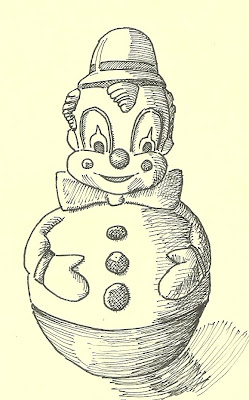
By far the largest very nearly had its shoulders out of the water. Bobbing around in a regular motion in the swell it suddenly reminded me of a "Roly Poly Clown" a younger cousin had one when I a very young kid myself. No matter how often you knocked it over it always rocked back upright with a ringing bell inside. It was very worn and had much of its paint either faded or rubbed off. I couldn't draw nor photograph the seals due to the weather conditions so I give you the "Roly Poly Clown" I have drawn upon my return to the warmth of home (image found on Internet, my memory isn't quite that good!)


So what were they up to?

a) Rocking about in the swell fully or half asleep?

b) Some normal seal behaviour I've not noticed before (I'm no expert)?

c) Just messing with my head? - my favorite option.

Sunday, 12 September 2010

Please (don't) "Mind the Gap"

The idea was that the blog would keep me drawing -OPPS, Sorry. Work, health, employment tribunals, travel off the island, and helping Sue set her geophysical consultancy up and running all got in the way. Lets just call it "Life".
So time to start again. Having just been off the island for a couple of weeks doing survey work in Aberdeenshire (looking for a couple of 17th Century formal gardens) I give you a small corner of Castle Fraser, the first of two sites we worked on.

It was very nice, but equipment failures and poor results took the shine off a little bit. Unfortunately this was Sue's first contract as a self employed consultant. However, when the site was excavated the following week the poor results where explained - the gardens had been largely removed in the 1800's as part of landscaping for a "natural" parkland as was then the fashion. The actual castle can be seen below with Sue taking her turn at surveying, less a castle and more a fortified home, very like a French Chateau (turrets and conical tiling). All Scottish Baronial Gothic.


The following week was Fyvie Castle, much much grander and very nice and good results. They start digging there in about a weeks time, so "fingers crossed" that the results really have shown the gardens (and other features). Both properties belong to the National Trust for Scotland.
Regards the sketch in my small moleskine I cannot remember if it was my original intention but it's come out all "Grimm's Fairy Tales" looking - I like it! Don't often say that about my own stuff!

Wednesday, 14 July 2010

A Harness of Gradiometers


A gradiometer is an instrument that senses, or rather records tiny changes in the earth's magnetic field. As such they are able to "see" ditches, pits, walls, hearths, and furness'. Well sometimes - they are a quick efficient means of archaeologically surveying an area (and that means cheap! always a bonus!) however " an absence of results does not mean an absence of archaeology". Sometimes the archaeology just isn't magnetically different enough, or can be 'masked' by modern detritus/development. Iron overloads the instrument and you wouldn't believe how much iron based rubbish is scattered around, even in rural situations. Until recently Sue and I were using a bartington, see below surveying on Iona. They require a harness over your shoulders to hang the instrument in front of you.


The one we preferred was the original, a hard alloy frame looking like roman armour over your shoulders -otherwise referred to as the "Xena" harness (detail below).

Their are several others, popular amongst our colleagues is a home made soft harness. It's like a sideways figure 8 that clips to the instrument and is called the "Soft" Harness. Although it acts more like a cross your heart wonder bra, but that name would be politically incorrect, too long and probably not popular with female staff (which is why you're not getting a close up photo of that one!)
There is now a new one supplied by Bartington that is like a day sack. The instrument attaches at the front and a water pouch on the back acts as a counter balance, but at something like £600 just for the harness I doubt many are up grading!


Thursday, 8 July 2010

The Kitchener Monument

As part of our business idea I've been looking round Orkney for archaeology, sites of natural beauty, or wildlife that will be recognisable and of intrest to locals or tourists. On the far west coast of the Orcadian mainland is the Kitchener Monument on Marwick Head overlooking the Atlantic. It commerates the loss of Lord Kitchener in the First World War, whilst on route to Russia to help stiffen there resolve and improve their performance in the war. It is assumed that his ship struck a mine shortly after leaving Scapa Flow, where the Home Fleet was based. The monument was erected in 1926 by the people of the Orkney Islands.


It was an interesting problem - how do you make a plain stone tower on a barren hill top look interesting? Well Lord Kitchener was the model for the famous poster from the First World War so I combined the two. 0.3 and 0.7 staedtler pen in large moleskine sketch book (approx 15" x 6")

Friday, 2 July 2010

Stones and Ink


This is one of the houses at Skara Brae, a Neolithic village and part of Orkney's World Heritage Site (this was done on A4 with Staedler o.3 and 0.7). It is meant to be part of a series of designs for some t-shirts; part of a business idea Sue and I have whilst the wolf is banging and scraping at the door! Unfortunately the tourist season is nearly half over and the "pressure" of producing enough designs at short notice isn't helping any either! So what do you think - it would have a small company logo/motif at the bottom right hand corner along with the name "Skara Brae, Orkney" ??? white on black, red on green, red on blue, etc.


The Village was first uncovered in the late 1800's when storms exposed it under the sand dunes that had covered it for a very very long time. Its was excavated between 1925 and 1930 and is now known to date from , at its earliest, 3,200 BC. All the houses have the same 'template' with 'side board' facing the low entrance, fire place in the centre, bed stalls to left and right. Archaeological investigation also showed that 'industrial' activity was always confined to the same set areas. The passage ways through the village also appear to heavily proscribed as to use and route. All in all a very structured life with lots of taboo or organisation. A plan is below..


Below is also another design, for the interior of Maes Howe, a Neolithic Chambered Cairn (or Tomb) from about 2,700 BC. Also part of the World Heritage Site.


So living dangerously -"Wada ya think???"

Friday, 25 June 2010

Future Potential?


This is a drawing of an abandoned croft a couple of miles down the road from where we live. There are many such scattered across the Orcadian landscape, generally Orcadians prefer to build anew rather than do up (more room and facilities presumably). So often you can see a new house next to a ruinous stone building (for storage) next to a complete ruin or pile of stones, as every few generations a new building is constructed. Occasionally the old crofts are being done up or as is happening not far from this croft an old building is being incorporated into the new build - which is nice to see. This practise dates back to at least Viking times, I worked on a site on Westray where 3 Viking farms had each been built next to the proceeding one (mere feet apart) leading perpendicularly inland from the beach, over time.


This drawing was done this week as part of some design work for a business project that Sue (my wife) and I have, but proved unsuitable so I present it for you here...


Staedler 0.3 and 0.1 disposable pens in A4 sketch pad, original scan approx 8"x5"

Sunday, 20 June 2010

An Annoyance of Visitors

Picture this, if you will, ...

You're knelt or squatting at the bottom of your trench about a metre below ground surface. The trench is miles from civilisation and not even visible from the nearest track. You are working hard when you become aware of a presence above your muddy, intriguing, and challenging environment. You look up above the edge of your trench to see a pair of legs attached to inappropriate footwear, all of which have seen better days and that have suffered from crossing the fields to your location. Before looking further you hear the, predictable, words "Found any dead bodies yet?", a remark followed by the self-appreciating laughter of the one delivering them...... The visitors/public has arrived!


OK I'm being unfair. The vast majority of visitors to site are polite, interested, intelligent, and enquiring. Even if they arrive ill-informed and have little knowledge, they want to know more of what's going on, they want to "understand". The vast majority that is, unfortunately, it's the other ones that you tend to remember - the idiots and fortunatly the odd bright star...


I remember explaining geophysics to a tourist (an old lady about 80 y.o) visiting our site on Shetland. Trying to explain in very simple terms she stopped me to explain that she was probably the first women to have attended her University and subsequently received a Doctorate in Physics, she understood the principles better than I did, and was exceedingly nice about it.


But my predominant memory of site visitors is of digging in North Yorkshire, in the Vale of Pickering. Standing at the side of the trench with some spare time on my hands I was emptying the buckets of spoil of those working hard below me (as it should be in the natural order of things!). I was explaining to the diggers in the trench that I wanted a dog, preferably a German Shepard, that would be trained to attack on hearing a certain phrase. If you uttered the ubiquitous, oft heard, phrase"Found any gold yet?" the dog would have your throat out before you could start laughing at your own joke! At this point I looked out across the field of beet, muddy wet and green, to see a couple approaching, no mean feat as we had not advertised our location and nor were we visible from the road. I told the diggers, who could not see them, that we had visitors. The most unpopular member of our disparate group, known to one and all as the "mad axe murderer" (you had to meet him and be there) said "it'll be mi purunts". I replied enquiring if his mother often wore a denim mini skirt, white high heels, and sported a bee-hive hair-do? ( this was the mid 1990's and predated Amy Winehouse's re-introduction of the bee-hive to the fashion conscious). Axe murderer replied that it was, indeed his "purunts".


Upon reaching the trench the mother looked down and asked (you guessed it..) "Found any gold yet?", before she could laugh at her own joke the trench erupted into gales of laughter. All we were missing was a German Shepard....